

Table of Contents
The rapid limitation of online tracking is reshaping the digital Marketing landscape, creating significant challenges for businesses that depend on data-driven marketing. To stay competitive, brands must learn to adapt to this evolving environment.
In the past, companies relied on traditional advertising channels such as television and physical displays, focusing heavily on creative messaging to attract customers. Advertisers often joked that half of their budget was wasted—they simply couldn’t identify which half.
The rise of the internet changed this reality. Digital platforms introduced targeted advertising, allowing businesses to reach specific audiences with unprecedented accuracy.
As online activity surged, the volume of available ad space expanded dramatically. This growth gave rise to a highly sophisticated advertising ecosystem involving marketers, agencies, publishers, and technology platforms—all designed to connect the right users with the right ads at the right time.
Consumers, meanwhile, began spending more time online and generating vast amounts of behavioural and demographic data. This data enabled advanced targeting, precise performance measurement, and detailed attribution modelling. Today, according to Statista, nearly 75% of all advertising spending is allocated to digital channels.
However, this transformation brought unintended consequences. The ability to collect and analyse immense amounts of data placed outsized power in the hands of major tech companies, particularly Google and Meta, who now dominate the digital Marketing marketplace.
Furthermore, the sheer volume of data collected—and the number of parties involved in processing it—has led to major privacy concerns. Even anonymised information can often be linked back to individuals by combining multiple data points, a risk heightened by the widespread exchange of consumer data across platforms.
Privacy vs Policy: How New Rules Are Reshaping Digital Advertising
In recent years, global privacy regulations like the EU’s GDPR have certainly influenced how the advertising industry collects and uses data. However, the most disruptive changes are coming not from governments, but from policy shifts introduced by major tech giants such as Google and Apple.
Google’s move away from third-party cookies
Google has announced plans to eliminate third-party cookies—long the foundation of online tracking. This change will prevent advertisers from following users across websites and instead provide only aggregated, interest-based insights, significantly reducing the precision of audience targeting.
Apple’s App Tracking Transparency (ATT) and its impact
Apple’s 2021 App Tracking Transparency update marked another major turning point. Under this policy, apps can no longer automatically track users across other apps and mobile sites. This removes the clear, trackable path between an online ad and a purchase, making attribution far more difficult.
Platforms heavily reliant on cross-app tracking—especially Meta—have been hit hard, losing much of the granular data that once fuelled their ad targeting capabilities. To fill this gap, Apple has introduced probabilistic campaign-level measurement, offering advertisers a general indication of whether a campaign likely led to a conversion.
A new era of data: first-party, zero-party, and proprietary
Together, these changes have drastically reduced the industry’s ability to target and measure individual user behaviour. Yet digital consumers remain reachable—just not in the same way. The power has shifted from third-party tracking to proprietary data sources, including:
- First-party data: information collected directly from customers
- Zero-party data: information customers willingly share
- Proprietary audience insights: data owned and controlled by individual platforms
As a result, the digital Marketing landscape is undergoing a major transformation. Businesses that invest in building strong first-party and zero-party data strategies will be best positioned to succeed in a world where privacy and policy take priority.
New Advertising Strategies in a Privacy-First Era
As third-party tracking declines, major consumer brands are shifting towards new advertising models built on their own proprietary data. Leading retailers, hotel groups, and streaming platforms are increasingly monetising their first-party customer insights by launching in-house advertising networks. These platforms allow brands to reach consumers at high-intent moments, using accurate, consent-based data rather than external tracking tools.
A key development in this space is the rise of retail media networks. Retailers now sell advertising placements across their e-commerce sites, giving marketers access to audiences who are already browsing products and ready to make a purchase. This approach is accessible even for smaller brands and strongly supports contextual advertising, where ads appear in highly relevant environments—much like Amazon’s recommendation engine.
At the same time, AdTech innovation is accelerating. AI-powered tools are becoming essential for refining contextual placements, predicting user behaviour, and maximising campaign efficiency without relying on personal identifiers. These technologies are expected to see significant growth as advertisers look for smarter ways to reach consumers in a privacy-restricted ecosystem.
The expansion of streaming platforms is also reshaping the media mix. With hybrid subscription-and-ad models, streaming services provide a powerful channel for engaging younger audiences who spend less time on traditional TV. As marketing budgets shift towards these digital environments, advertisers gain more opportunities for targeted and interactive experiences.
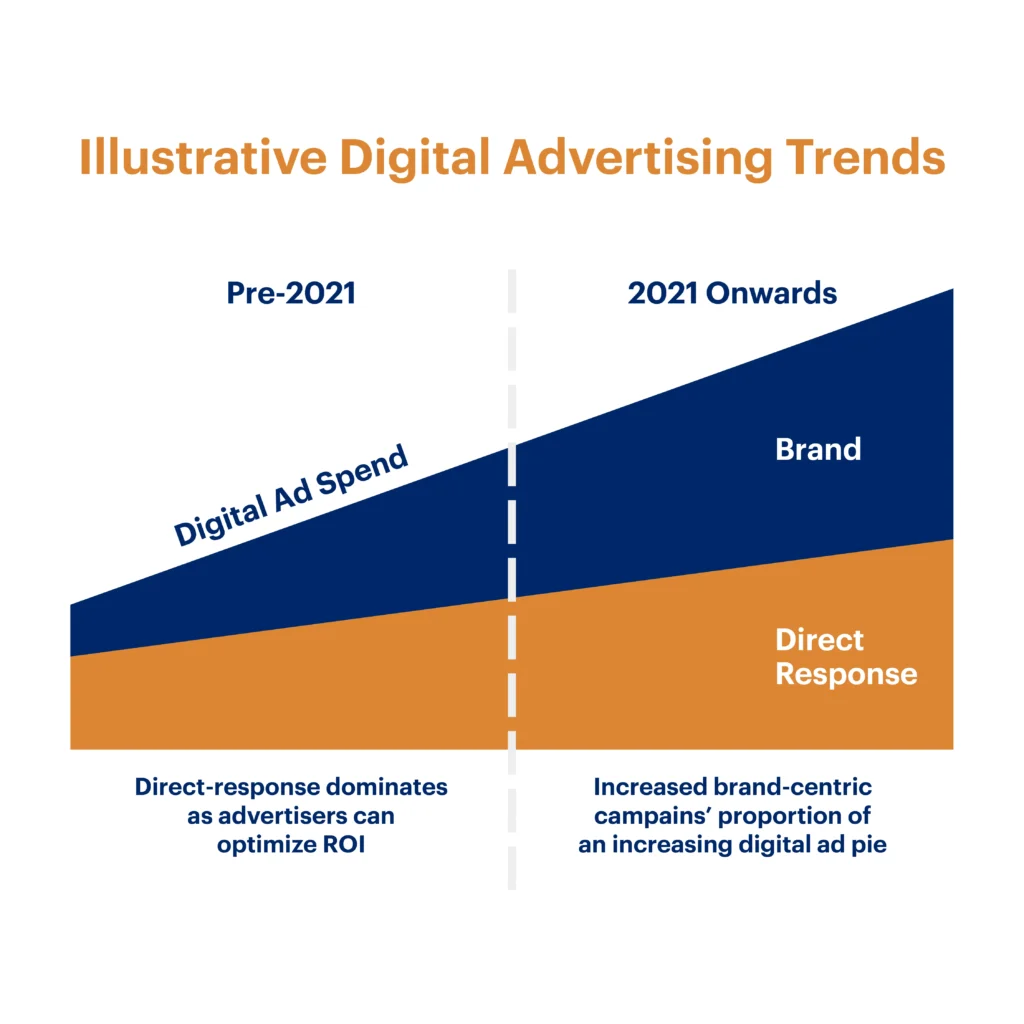
Finally, the industry is witnessing a renewed emphasis on brand-building campaigns. With performance tracking becoming less precise, companies are investing more in long-term strategies that strengthen brand trust, awareness, and loyalty—rather than just short-term, sales-driven ads.
This evolving landscape offers substantial opportunities for businesses that prioritise first-party data, contextual targeting, and strong brand identity.
Implications for Growth Businesses
For fast-growing companies, today’s digital Marketing Landscape is far more challenging and dynamic than it once was. Businesses can no longer rely on large, undirected ad budgets on Meta or Google and assume they will generate consistent returns. Instead, success now depends on strategic, context-driven marketing approaches that precisely target the right audiences while maximising budget efficiency.
These shifts reinforce a long-standing approach taken by the Permira funds: investing in distinctive, resilient brands rather than relying on high-spend performance marketing to drive short-term sales. As digital targeting becomes less predictable, strong brand identity and customer trust become even more essential for sustainable growth.
This evolving environment also creates a valuable opportunity. Companies that invest in creative brand positioning, robust data capabilities, and modern marketing talent will be better equipped to scale. Our value-creation focus is centred on ensuring portfolio businesses build the right marketing foundations—combining brand strategy, first-party data expertise, and digital capabilities—to compete effectively and grow in a privacy-first, platform-shifting world.
Disclaimer
All news on Hindi Khabra are computer generated and provided by third party sources, so read and verify carefully. Hindi Khabra will not be responsible for any issues.