


Table of Contents
Can AI Replace Hackers? The Future of Cybersecurity
Cybersecurity is changing rapidly, and artificial intelligence is becoming one of the most powerful technologies in the digital world. Many people are now asking an important question: Can AI Replace Hackers? From automated threat detection to AI-powered security tools, the future of cybersecurity is evolving faster than ever.
Hackers have traditionally relied on human skills, creativity, and technical knowledge to exploit systems. But today, AI can scan networks, identify vulnerabilities, and even respond to cyberattacks within seconds. This has created both excitement and fear in the tech industry.
In this article, we will explore whether AI can truly replace hackers, how AI is transforming cybersecurity, and what the future may look like for businesses, ethical hackers, and internet users.
ADVERTISEMENT
What Is AI in Cybersecurity?
Artificial intelligence in cybersecurity refers to machines and software systems that can learn, analyze, and make decisions to improve digital security. AI tools use machine learning, automation, and data analysis to detect unusual activities and stop threats before they become dangerous.
Modern cybersecurity systems powered by AI can:
- Detect malware faster
- Identify suspicious login attempts
- Monitor large networks in real time
- Predict cyber threats
- Automate security responses
Why People Ask: Can AI Replace Hackers?
The question “Can AI Replace Hackers” has become popular because AI is now capable of performing tasks that once required expert hackers.
Companies around the world are now investing heavily in AI-based cybersecurity solutions because cyberattacks are becoming more advanced every year.
For example, AI can:
- Automatically scan websites for vulnerabilities
- Generate phishing detection systems
- Analyze millions of files instantly
- Learn attack patterns from previous cyber threats
Because of these capabilities, some people believe AI may eventually replace human hackers completely.
ADVERTISEMENT
However, the reality is more complex.
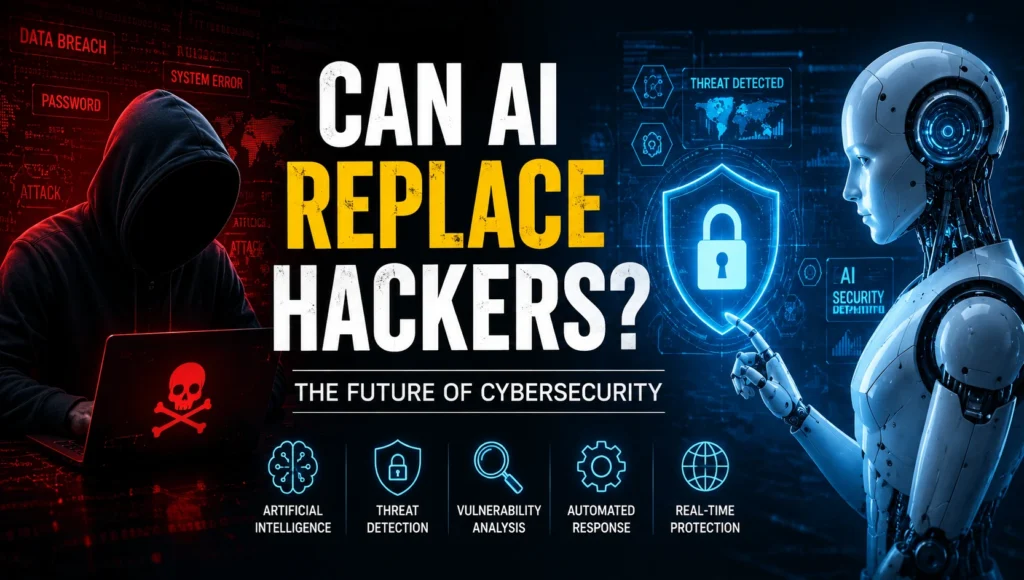
The Difference Between Hackers and AI
Hackers are human beings who think creatively and adapt quickly. AI, on the other hand, depends on data, training models, and algorithms.
Human Hackers
Human hackers can:
- Think outside the box
- Create new attack methods
- Manipulate people through social engineering
- Adapt to unexpected situations
Artificial Intelligence
AI systems can:
ADVERTISEMENT
- Process huge amounts of data quickly
- Detect patterns humans may miss
- Automate repetitive tasks
- Work 24/7 without breaks
This means AI is extremely powerful, but it still lacks true human creativity and emotional understanding.
How AI Is Helping Ethical Hackers
Ethical hackers, also called white-hat hackers, use AI tools to strengthen cybersecurity systems. Instead of replacing hackers, AI is currently acting more like an assistant.
AI helps ethical hackers by:
- Speeding up vulnerability scanning
- Detecting suspicious behavior
- Improving penetration testing
- Automating threat intelligence
This combination of human expertise and AI technology creates stronger security systems than either could achieve alone.
Can AI Become a Cybercriminal?
One major concern is that cybercriminals are also using AI to improve attacks. This means AI is not only helping cybersecurity experts but also empowering malicious hackers.
AI-powered cyberattacks may include:
- Smarter phishing emails
- Automated password cracking
- Deepfake scams
- Malware that learns from defenses
As AI technology grows, cybercrime may become more dangerous and difficult to detect.
That is why cybersecurity experts believe human intelligence will still remain important in fighting digital threats.
Industries Using AI for Cybersecurity
Many industries are already using AI to protect sensitive data and online systems.
Banking Sector
Banks use AI to detect fraudulent transactions and suspicious account activity in real time.
Healthcare Industry
Hospitals use AI to protect patient records and prevent ransomware attacks.
E-commerce Websites
Online shopping platforms use AI to monitor payment fraud and fake accounts.
Government Organizations
Governments use AI-powered surveillance and cybersecurity systems to defend against national cyber threats.
These examples show how AI is becoming essential in modern cybersecurity.
Advantages of AI in Cybersecurity
There are several benefits of using AI in cybersecurity.
1. Faster Threat Detection
AI can identify threats within seconds, reducing response time significantly.
2. Continuous Monitoring
Unlike humans, AI systems can monitor networks 24/7 without fatigue.
3. Reduced Human Error
Many cyberattacks happen because of human mistakes. AI can reduce such risks through automation.
4. Improved Data Analysis
AI can analyze massive amounts of data quickly and accurately.
5. Cost Efficiency
Businesses can automate many security tasks, saving time and money.
These advantages explain why AI is becoming a major part of cybersecurity strategies worldwide.
Limitations of AI in Cybersecurity
Even though AI is powerful, it still has several limitations.
Lack of Creativity
AI cannot fully replicate human creativity and intuition.
Dependence on Data
AI systems need quality data to function properly. Poor data can lead to inaccurate results.
Risk of False Positives
Sometimes AI may incorrectly flag safe activities as threats.
Vulnerability to Manipulation
Hackers can also target AI systems themselves using adversarial attacks.
Because of these limitations, AI alone cannot fully replace human cybersecurity professionals.
The Future of Cybersecurity
The future of cybersecurity will likely involve collaboration between humans and AI rather than complete replacement.
Cybersecurity experts believe:
- AI will automate routine security tasks
- Human hackers will focus on advanced problem-solving
- Ethical hacking will become more AI-assisted
- Cyber threats will become smarter and more automated
Businesses will increasingly depend on AI tools, but skilled cybersecurity professionals will still be needed to make strategic decisions.
So, the answer to “Can AI Replace Hackers” is not entirely yes or no. AI can replace some hacking tasks, but human intelligence remains essential.
Will AI Replace Ethical Hackers?
Ethical hackers should not fear AI replacing their jobs completely. Instead, AI is likely to transform their roles.
Future ethical hackers may:
- Use AI-powered testing tools
- Focus more on strategy and analysis
- Manage automated security systems
- Specialize in AI security itself
This means cybersecurity careers will continue to evolve rather than disappear.
Final Thoughts
Artificial intelligence is changing the cybersecurity industry at an incredible speed. AI can detect threats, automate responses, and improve digital security systems more efficiently than ever before. However, human hackers still possess creativity, critical thinking, and adaptability that machines cannot fully replicate.
The future of cybersecurity will most likely be a partnership between humans and AI. Ethical hackers will continue to play a major role while using AI tools to become faster and more effective.
So, can AI replace hackers? Not completely. But AI will definitely reshape the future of cybersecurity and change the way digital protection works forever.
Disclaimer
All news on Hindi Khabra are computer generated and provided by third party sources, so read and verify carefully. Hindi Khabra will not be responsible for any issues.